“People think dance music is superficial. But they’ve got it all wrong. The dance floor is not just a place. It’s a threshold, a ritualistic space. Where movement replaces language.”
Blending Chicago house, Detroit techno, two-step garage, acid house, and everything in between, Madonna returned to the dance floor with Confessions II—her most critically acclaimed album in over two decades and 10th No. 1 album on the Billboard 200. More than a sequel to 2005’s disco-inspired Confessions on a Dance Floor, the album is an impassioned love letter to the history of dance music, propelling listeners through the emotional arc of a raging night out—from the anticipation before the first drink to the euphoria of the dance floor to the quiet reflections that arrive at sunrise. But more on that later.
As part of one of the wildest album rollouts in recent memory (a partnership with the gay dating app, Grindr, for one?), Madonna welcomed her fans to the latest edition of “Club Confessions” at Brooklyn’s Knockdown Center this past Saturday, July 11. It marked the fourth iteration of Confessions II brought to life in rave form, with previous editions hosted at The Abbey in West Hollywood, Paradis Latin in Paris, and Magazine in London, plus a surprise performance in Times Square.
Celebrating the album’s success on Instagram, Madonna shared, “My dream was to make people dance this summer!! To bring people JOY!” And that’s precisely what she did last weekend, joined by longtime collaborator Stuart Price—co-producer of both Confessions II and Confessions on a Dance Floor—alongside a stacked DJ lineup featuring Honey Dijon, Fcukers, Junior Sanchez, and Sam-E.
Inside Club Confessions
Fans entered the venue through a larger-than-life recreation of Madonna’s legs—yes, you read that right—and a 2000s-style speaker, as seen on the album’s first promo image. Inside, walls were covered with floor-to-ceiling patchworks of wheat paste posters in the style of Madonna’s promotional artwork seen filling the streets of cities across the United States and Europe.

Continuing through a laser-filled, forest-themed hallway, Knockdown Center brought to life the “Good for the Soul” sequence from Confessions II: The Film, a visual project spanning the first five songs off the album that premiered at the Tribeca Festival last month. At the bar, fans were treated to Madonna-themed cocktails (thanks to her partnership with Absolut) under LED recreations of the album cover, as Fcukers opened with a high-energy set.
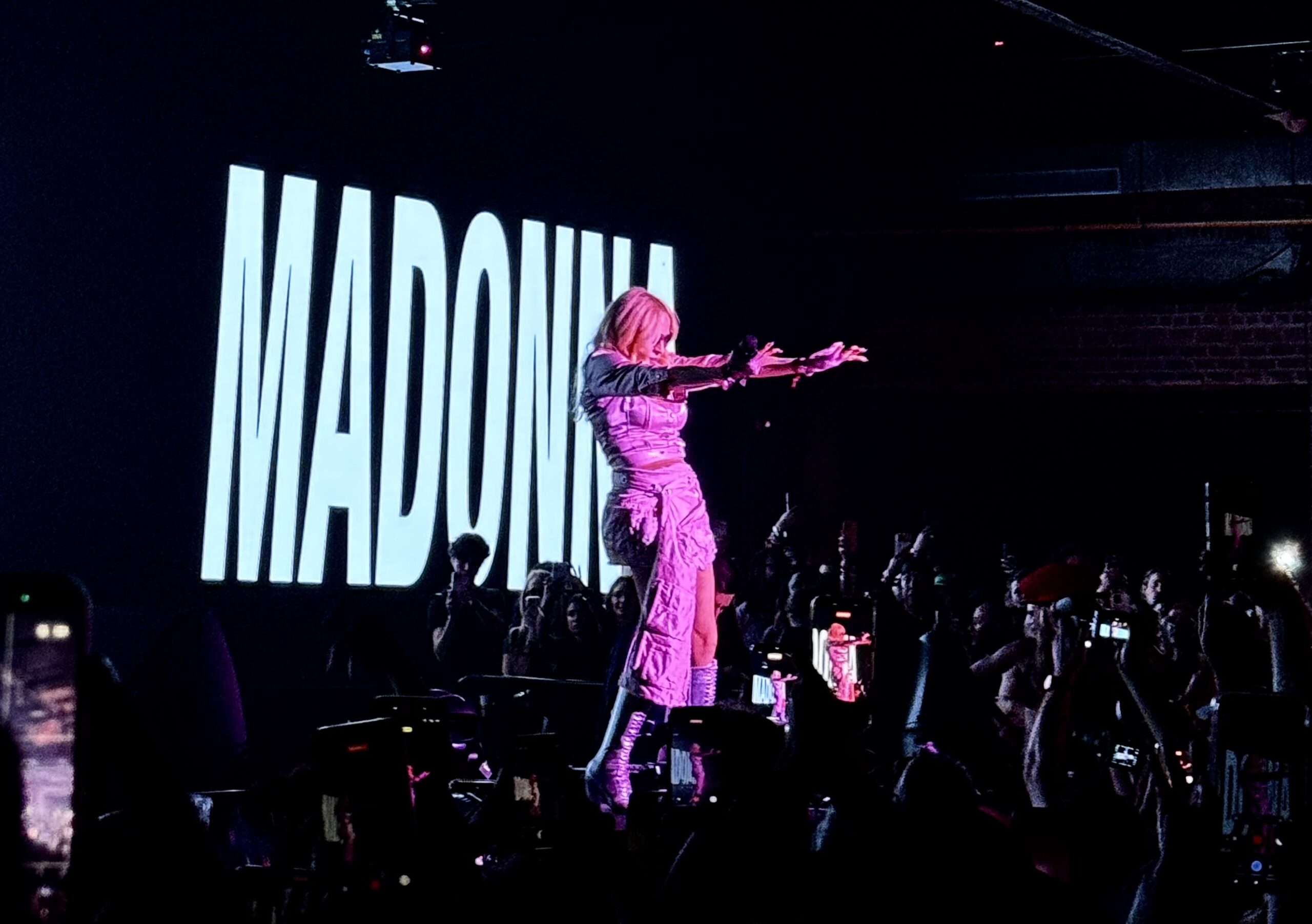
A little after 1 a.m., the house lights dimmed and Stuart Price took the decks. Moments later, Madonna emerged to what may have been the loudest roar Knockdown Center has ever heard, as the unmistakable intro “It’s Motha!” rattled through the warehouse. Behind them, the full-stage LED screens flashed the album’s track list, promotional visuals, and one unmistakable word in floor-to-ceiling lettering: “MADONNA.”
Madonna Hits the Stage
Madge and Price kicked off the night with “One Step Away,” a hypnotic house-inspired track with an opening manifesto that tells us what the album is all about: “The dance floor is not just a place. It’s a threshold, a ritualistic space.” A smooth transition into “Love Without Words” was met with cheers from the crowd, as the dark and sensual house track opened with another spoken-word intro from M.
What followed was neither a traditional Madonna performance, nor a traditional DJ set. Yes, Madonna sang on-and-off while dancing atop the decks during the sensual and experimental “School” (showing us just how flexible she is, even at 67 years old). And yes, Price left his indelible mark on the warehouse venue, mixing the album’s songs with old-school house classics like Marshall Jefferson’s “Move Your Body” and Mixmasters’ “In the Mix.” But what truly followed was Madonna showing us why she made this album—to make people dance.

Despite the sea of phones, the night became a living thesis statement for Confessions II. The album wasn’t meant to be a collection of trending singles, as Price recently revealed in an interview with Attitude. “We wanted to go against the grain,” he shared, when explaining why they chose to create the nonstop mix heard on the album. As seen at Knockdown Center, Confessions II was built for packed warehouses, sweat-soaked clubs, and most importantly, strangers losing themselves on the dance floor together.
While the event was chock-full of celebrity guests, most dancing behind Madonna and the decks (Kaytranada, Pabllo Vittar, Debi Mazar, Frankie Grande, Sky Ferreira, and Kim Petras, to name a few), the real magic was in the crowd. When Madonna took the mic, declaring “Everyone here is a work of art,” it was clear even she realized that the vision behind Confessions II had become a reality. The “Danceteria” lyric tease was followed by what seemed like every person in attendance scream-singing each word of the ‘90s house-inspired track—a reaction that made her break out in laughter and surprise.
Price and Madonna played a set spanning a little under an hour. The duo covered dance heavy-hitters off the album, mixed alongside classics from M’s back catalog, before ending the set with timeless hits from the original Confessions, “Hung Up” and “Get Together.” Honey Dijon closed the night with her signature rhythmic grooves, starting off with her unreleased remix of Madonna’s 1983 classic “Physical Attraction.” Fresh off day one of her own “Love Sensation” daytime event at Knockdown Center’s outdoor venue, The Ruins, she kept the warehouse moving well into the early morning.
Confessions II: A Masterpiece Built for the Dance Floor
Be it through the album itself or its legendary promotional campaign designed specifically for the clubs and the fans that fill it, Madonna has changed the game once again—over four decades since her debut. What ultimately makes Confessions II remarkable is how deeply she immersed herself in dance music history while weaving some of the most vulnerable, biographical, and ‘confessional’ songwriting of her career into its fabric.
Her reverence for dance music is reflected in the multitude of sub-genres present on the album, the creative samples used throughout (Lil Louis’s “French Kiss” on “I Feel So Free,” Inner City’s “Good Life” on “Bring Your Love,” Lou Reed’s “Walk on the Wild Side” on “Danceteria”), and across the album’s production credits.
Confessions II is produced by Price and Madonna herself, with additional credits to some of EDM’s heavy hitters. Martin Garrix co-produced “Bizarre,” a synth-pop club track that the Dutch superstar has been performing ever since its debut at the Barclays Center in June. PARISI, the Italian electronic music duo, provided additional production on four of the album’s tracks: “Love Without Words,” the Sabrina Carpenter duet “Bring Your Love,” the hard-hitting “Everything,” and the downtempo “Betrayal.” And while not on the main album, Honey Dijon’s remixes of “Bring Your Love” are featured on the remix package, Confessions II: Afterhours Edition, alongside “Love Sensation” remixes by Floorplan and Saltue.
This is an album that undoubtedly deserves a full listen from start to finish. Lyrically, the album features some of Madonna’s most vulnerable and introspective songwriting to date: a heart-to-heart with her daughter (“The Test”), a scathing rebuke of her stepmother (“Betrayal”), the grief of losing her brother (“Fragile”), reflections on her early life as a struggling artist in New York (“L.E.S. Girl”), memories of the chaos that characterized her marriage to Sean Penn (“Bizarre”), and an autobiographical retelling of the friends and artists who shaped her creative life (“Danceteria”).
But the album’s structure is what truly makes it shine. Sequenced as a continuous DJ set, Confessions II unfolds as both a night out and a reflection on Madonna’s life, with each chapter of the evening mirroring a different emotional moment in her story.
“I Feel So Free” through “One Step Away” captures the anticipation of a legendary night and the rush of excitement heading to the club. “Bring Your Love” to “Read My Lips” throws the club doors wide open with the joyful bliss of dance floor happiness and the community that comes with it.
The run from “Everything” to “Bizarre” might be one of her best, raising the energy to peak euphoria when the vibes are just right and the energy reaches its pinnacle. “School” shifts into the more experimental, grimy sounds of the afterparty, while “Fragile” becomes the night’s ‘crying on the dance floor’ moment.
The album’s four final tracks, “My Sins Are My Savior” to “L.E.S. Girl,” represent the quiet moments that follow a great night—the reflective Uber ride home, the sun rising over the city, the birds chirping as a new day arrives—and the thoughts that inevitably accompany it.
It’s rare these days that an album takes its listeners on a true journey, both musically and metaphorically. But Madonna does just that here. Instead of chasing contemporary pop trends or taking a stab at radio-friendly pop EDM (as previously heard on 2012’s MDNA), Madonna not only invites us into her world, she reconnects with the underground that shaped her own. House, techno, garage, acid, disco—Confessions II celebrates dance music in its purest forms. Forty-three years into one of pop music’s most decorated careers, she remains a student of the dance floor as much as its queen.
She may not be the first artist that comes to mind when people think of rave culture. But perhaps she should be. Even for one night in Brooklyn, Madonna reminds us that she never truly left the dance floor. And Confessions II is a reminder that long before dance music conquered the mainstream, Madonna was helping bring it there. If this album proves anything, it’s that her relationship with dance music has always been one of participation and admiration, rather than imitation or capitalization. She’s always spoken the language of dance music. Confessions II is simply her most fluent conversation with it in decades… if not her entire career.
So go on, meet Madonna on the dance floor and give Confessions II a worthwhile listen.